At kataoka, a piece of jewelry does not begin with a sketch. It begins with a stone. Before any design decision is made, Yoshinobu Kataoka studies the stone itself: its color under different light sources, its internal structure, the way it holds or releases light depending on the angle. The design that follows is not applied to the stone. It is derived from it. The stone's character determines the setting, the metal, the proportions, and the final form. This is not a philosophy stated after the fact. It is the sequence in which the work actually happens.
This approach inverts the standard industry process, where a setting is designed first and stones are selected to fit it. At kataoka, the stone is the fixed point. Everything else adapts. The result is jewelry where the relationship between stone and metal feels resolved rather than assembled, because the metal was shaped in response to what the stone already was.
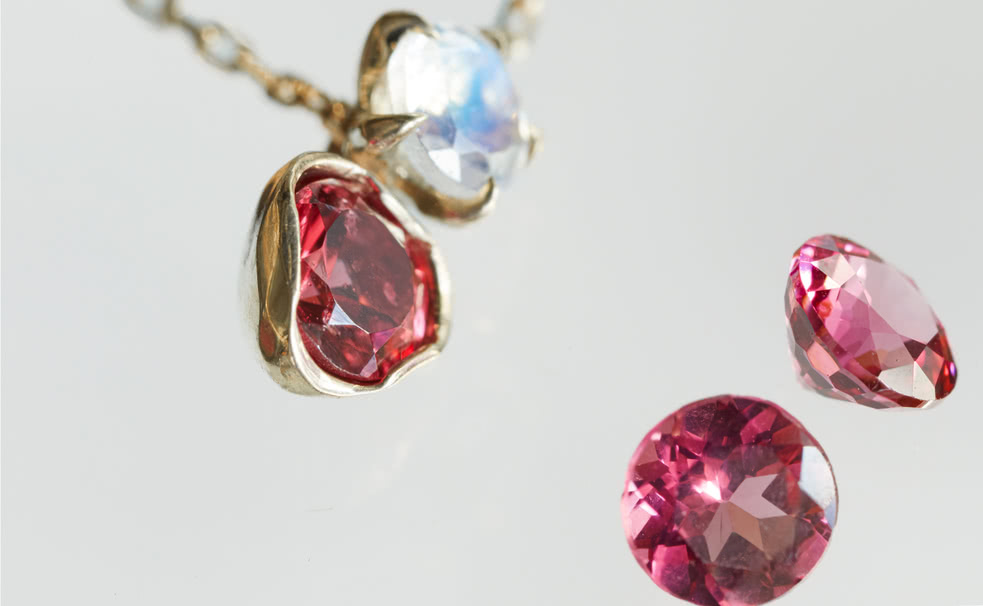
Selection, Not Specification
Conventional stone sourcing works by specification: a jeweler orders stones to a grade, a size, and a color range. The stones arrive pre-sorted. Design proceeds from there. Yoshinobu Kataoka's process is different. He sources ethically mined natural diamonds and gemstones, and then selects from them individually, not by grade sheet but by hand, under multiple light conditions, evaluating each stone for qualities that do not appear on a certificate.
What he looks for is presence. A stone with presence holds attention not because it is the most brilliant or the most flawless, but because something in its particular combination of color, depth, and internal light makes it singular. Two stones can share the same carat weight, the same clarity grade, and the same color designation, and one will have a quality the other does not. That quality cannot be graded because it is not a single measurable attribute. It is a relationship between attributes, and it can only be seen by someone who knows what to look for.
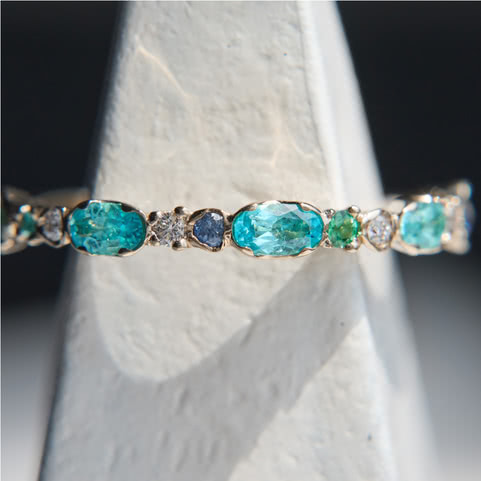
The Setting as Response
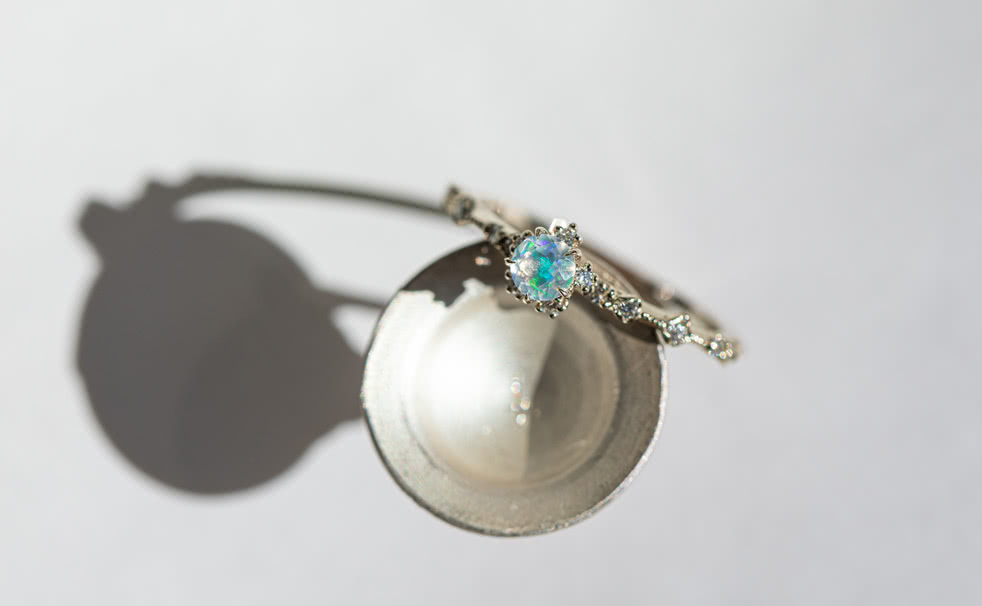
Once a stone is selected, the setting is designed around its specific geometry and optical behavior. A stone that disperses light broadly may be held in an open setting that allows light to enter from multiple angles. A stone with deep, concentrated color may receive a closer setting that frames the color without competing with it. The metal is shaped to follow the stone's contour rather than imposing a predetermined form.
This is where kataoka's custom-blended metals become part of the stone's story. The warmth of the house's proprietary beige gold, for example, interacts differently with a cool-toned sapphire than a standard yellow gold would. The alloy is not chosen for branding. It is chosen because its specific color temperature affects how the stone reads against the skin. The metal and the stone are considered as a single optical system, not as separate elements joined together.
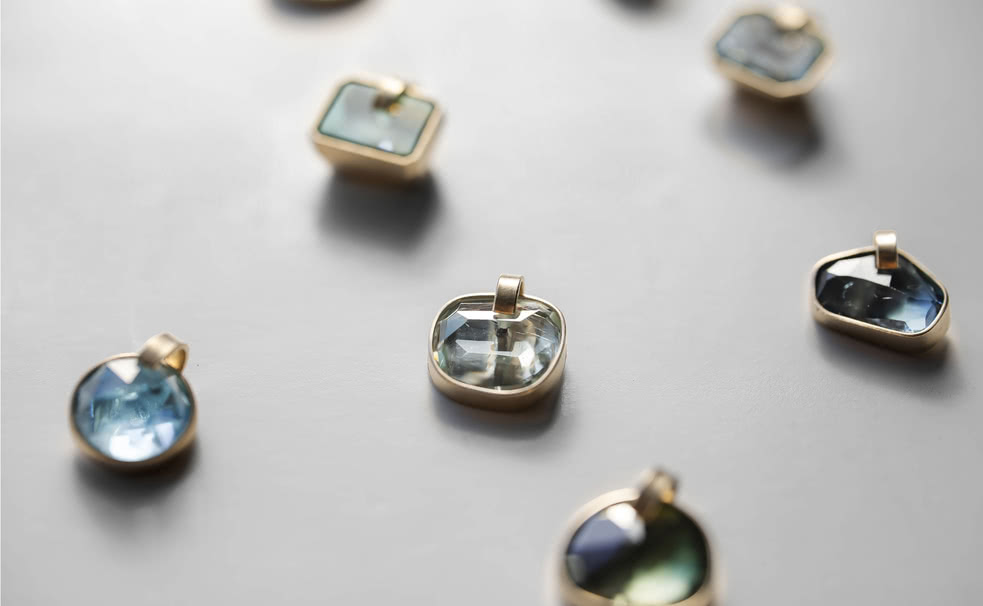
Character, Not Perfection
The jewelry industry's grading systems are designed to standardize. They rank stones on scales of clarity, color, and cut, with the highest grades commanding the highest prices. These systems are useful for commerce. They are less useful for understanding why a particular stone is beautiful.
Yoshinobu Kataoka selects stones that have character, which is a different quality than technical perfection. A subtle warmth in a diamond's body color. A silk-like inclusion in a sapphire that gives the stone depth rather than diminishing its clarity. A tourmaline whose green shifts toward teal under certain light. These are not qualities that survive grading. They are qualities that survive attention, and they are the reason two kataoka pieces using the same type of stone can look entirely different from each other. Each stone was chosen for what it specifically is, not for how closely it conforms to an ideal.
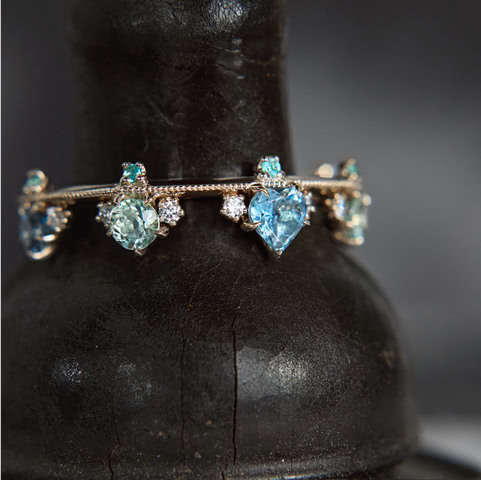
No Prescribed Meaning
For centuries, gemstones have carried assigned meanings. Emeralds for renewal. Sapphires for wisdom. Garnets for protection. These associations are part of the historical record, and they reflect a genuine human impulse to find significance in what the earth produces. But they are also inherited narratives that can reduce a stone to a symbol.
kataoka does not assign meaning to its gemstones. A stone is not chosen to represent something. It is chosen because its specific optical and material qualities made it the right stone for that piece. Whatever meaning it carries is the meaning its wearer brings to it over time, through the life lived while wearing it. This is a deliberate position: the stone's significance is not determined at the point of sale. It is accumulated through experience.
What Remains
A gemstone is, by geological fact, older than anything else in a piece of jewelry. The metal was refined. The setting was made. The stone was already there, formed over millions of years under conditions of pressure and heat that no human process replicates. It will outlast the setting, the wearer, and the era in which it was worn.
Yoshinobu Kataoka's work acknowledges this. The stone is not elevated by the jewelry. The jewelry is built to be worthy of the stone. Every decision in material, proportion, and craft is made in service of an object that existed long before the goldsmith's hand reached it, and will exist long after. This is not reverence as marketing language. It is the logical consequence of understanding what a gemstone actually is: the oldest, most enduring element in anything kataoka makes.